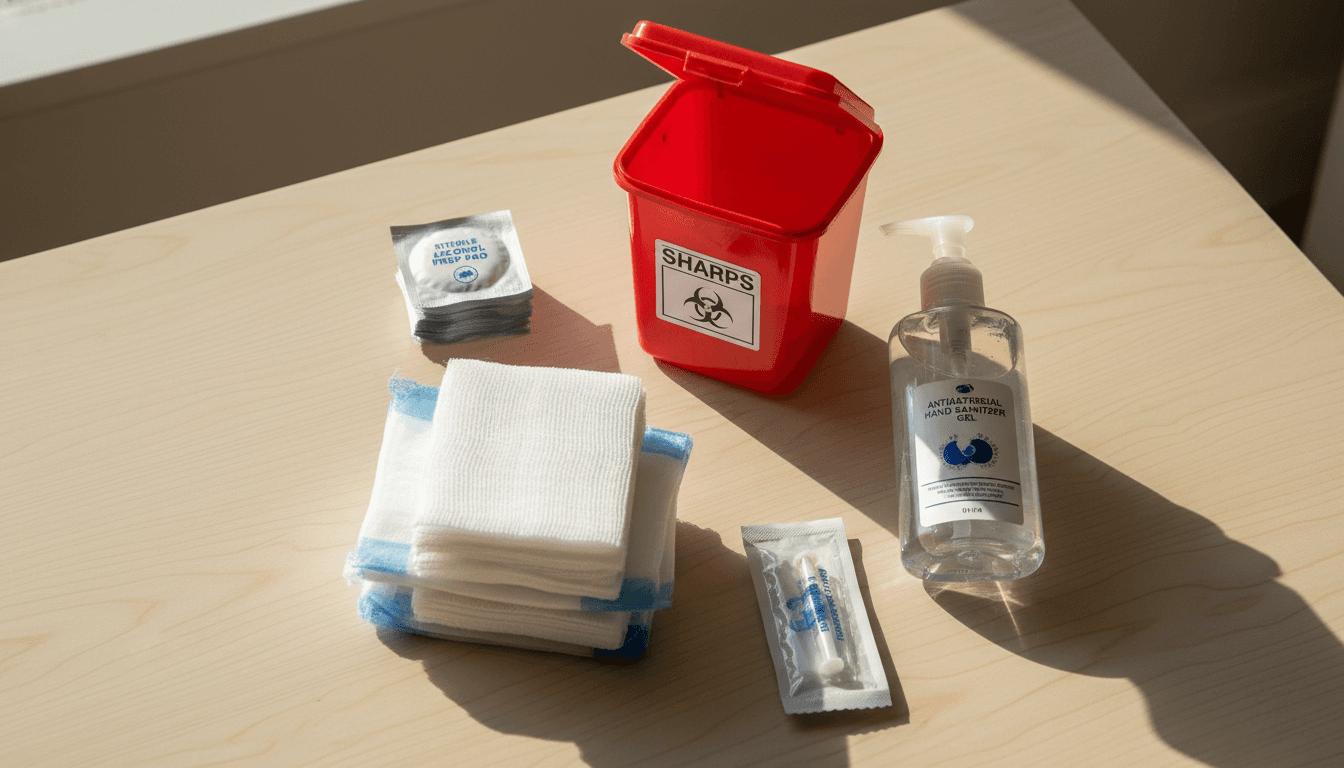
A new needle does not make a shared pen safe. Why the cartridge itself is the hazard, and how to label pens in a shared fridge.
Key points
- 01One pen, one person, for the life of the pen. Injection-safety guidance treats a pen device as belonging to a single named person from the moment it is dispensed until it goes in the sharps container. Changing the needle between users does not turn it into a shared device. If you read nothing else on this page, that is the sentence.
- 02The needle is not the only part that meets you. A pen is a multi-dose cartridge with a disposable needle screwed onto the front of it. The needle is thrown away after one use, but the cartridge stays in the device for weeks. Anything that reaches the cartridge stays with the pen and goes wherever the pen goes.
- 03Material can be drawn back as pressure equalises. Work on insulin pens describes blood and skin cells being drawn back toward the cartridge as the internal pressure equalises at the end of a dose and as the needle is withdrawn. That backflow is the proposed route by which one person's biological material ends up inside a device. Nothing about the pen looks any different afterwards.
- 04That is exactly why a fresh needle does not fix it. A new needle solves the contamination on the outside of the old needle and removes the risk of a blunted tip. It does nothing at all about the contents of the reservoir it screws onto. Two separate hazards, and the needle change only ever addressed one of them.
- 05The pathogens the literature names. Investigations into multipatient pen sharing discuss hepatitis B, hepatitis C and HIV as the bloodborne pathogens of concern. The measured probability from any single shared dose is described as low, but low is not zero, and that is why hospitals treat it as an exposure rather than a near miss.
- 06Hospitals rebuilt their systems around this. Quality and safety work published in the hospital literature asks whether one pen, one patient is even achievable on a busy ward, and the answer involved labelling at the point of dispensing, patient-specific storage bins and barcode checks at the bedside. A kitchen fridge has none of that unless you build it.
- 07Two identical pens in one fridge is a real hazard. Couples on the same prescription, a parent and a teenager on the same drug, and two residents in the same care home all end up with devices that look identical inside the same cold box. The mix-up is not carelessness, it is a design problem, and labelling is the fix.
- 08Label the pen, not only the carton. Cartons get flattened for recycling and pens end up loose in bags and bedside drawers. A name written on the barrel itself, clear of the dose window and the dial, is the label that survives. Add a colour strip so the check works before anyone is properly awake.
- 09The late-delivery temptation is the common one. A shipment slips, a pharmacy is out of stock, and there is an identical pen in the fridge belonging to someone else in the house. That is the moment the rule exists for. The call goes to the pharmacy, which can look at an emergency supply, a bridging quantity or a different presentation.
- 10Borrowing a few units counts as sharing. People reason that a partial dose from someone else's pen is a smaller version of the same act, so it must carry a smaller risk. The mechanism does not work that way, because the backflow happens on any injection regardless of how much was delivered. One dose from a borrowed pen makes that pen a shared device from then on.
- 11Lancing devices and meters are a separate rule. A lancing device holds a lancet in a platform that can carry blood even when the lancet is changed, and finger-stick meters have been implicated in transmission in shared-care settings. Those stay personal too. Give each person their own lancing device and their own meter, and never pass either across a table.
- 12If a pen has been shared, keep it. The instinct is to throw the device away and say nothing. Do the opposite. Stop using it, write do not use on the label, keep it somewhere safe, and call the prescriber for both people involved so the conversation about testing happens with the actual dates and the actual device in hand.
- 13Ask about testing rather than deciding alone. What follow-up is offered after a shared pen depends on the people involved, the timing and local protocol, and none of that is decidable from a web page. Bring the dates, the pen and the injection records. Our post on what to do if you injected the wrong medication describes the same reporting habit.
- 14Care homes and paid carers need it in writing. Where somebody else gives the injection, the control is a written name on the device and a labelled tray or bin per resident, applied at the point of dispensing rather than at the bedside. There is no such thing as a house pen kept for whoever needs one. Our post on storing injection supplies covers how the shelf should look.
Pre-injection checklist
- ✓One pen belongs to one person for the whole life of that pen. Fitting a new needle does not change that, and this post explains why the reservoir behind the needle is the part that matters.
- ✓The rule holds even when two people in the same house take the identical product at the identical strength. Same drug does not mean same device.
- ✓The related rule about lancing devices and finger-stick meters is separate and just as firm. Those are covered further down.
- ✓If a pen has already been shared, do not quietly bin it. Set it aside, stop using it, and call the prescriber who wrote it.
- ✓This is patient-education material about device handling. Your dose, your schedule and any testing after an exposure are decided by your prescriber, not by a website.
Step-by-step guide
- 1
Wash your hands and clear a shelf
Take everything injectable out of the fridge and put it on a clean surface. Wipe the shelf you are going to use. You want one shelf that holds nothing but medication, so nobody reaches past a salad box in the dark.
Pro tipAlways check the fluid is clear and colourless before injection. - 2
Keep every pen in its own carton
The carton carries the name, the strength, the batch number and the expiry date. A loose pen in a fridge drawer has lost most of the information that tells you whose it is. Our post on storing injection supplies covers the rest of the shelf.
Pro tipAlways check the fluid is clear and colourless before injection. - 3
Write the full name on the carton
Not initials. Two people in a household can share initials, and a hurried hand at six in the morning reads the first letter and stops. Write the full first name in large letters on the face of the box.
Pro tipAlways check the fluid is clear and colourless before injection. - 4
Write the same name on the pen body
Cartons get recycled and pens migrate. A label wrapped around the barrel of the pen itself, clear of the dose window and the dial, travels with the device into a bag, a cooler or a bedside drawer.
Pro tipAlways check the fluid is clear and colourless before injection. - 5
Add one colour per person
A strip of coloured tape on the carton and on the pen gives you a check that works before you have your glasses on. Colour is not the record, the written name is, but it catches the wrong hand early.
Pro tipAlways check the fluid is clear and colourless before injection. - 6
Give each person a separate lidded container
Two clear boxes on the same shelf, each with a name on the lid, means a pen never sits loose next to somebody else's. It also stops a pen rolling to the back wall where it can freeze.
Pro tipAlways check the fluid is clear and colourless before injection. - 7
Store the needles with their owner
Put each person's pen needle box inside their own container. This removes the situation where one shared needle box sits on the counter and two people take turns at it with two different pens.
Pro tipAlways check the fluid is clear and colourless before injection. - 8
Set up an injection record for each person
One sheet per person, kept with their box, with the date, the site and the pen in use. Our post on keeping an injection record covers what to write. It is also the document you will want if a mix-up ever happens.
Pro tipAlways check the fluid is clear and colourless before injection. - 9
Do a check when a new box arrives
Every time a prescription is collected, label the new carton and the new pens before they go in the fridge. Unlabelled new stock sitting next to labelled old stock is where the system quietly breaks.
Pro tipAlways check the fluid is clear and colourless before injection. - 10
Split the kit again when you travel
Two people travelling together pack two bags, not one shared pouch. The same applies to a cool bag. Keep the cartons, because a border check or a pharmacy in another country will ask for them.
Pro tipAlways check the fluid is clear and colourless before injection.
After the injection
- Photograph the finished shelf so anyone in the house can see how it is meant to look.
- Tell everyone who opens that fridge what the colours mean, including visitors and paid carers.
- Re-label at every collection, before the new cartons go in the fridge.
- Keep each person's injection record with their own box rather than in a shared drawer.
- Dispose of finished pens in a sharps container, as our post on how to dispose of needles describes.
Common mistakes
- Any situation where two people have used the same pen, which is a call to the prescriber for both of them rather than something to sort out privately.
- A needlestick from someone else's used needle, which is handled as an exposure and reported the same day.
- A shared lancing device or a shared finger-stick meter, which carries the same conversation as a shared pen.
- Spreading redness, heat, swelling or pus at an injection site, with or without fever.
- Yellowing of the skin or the eyes, dark urine, unexplained fatigue or fever in the weeks after a known sharing incident.
- A pen that somebody else has clearly used, identified by an unfamiliar dose left on the dial or a needle already fitted.
- Any doubt about whose pen is in your hand, which is a reason to stop and check rather than to guess.
Frequently asked questions
Is it safe to share a pen if I put on a brand new needle?+
No. The needle is only the front of the device. Blood and cells can be drawn back toward the cartridge as pressure equalises when the needle is withdrawn, and the cartridge stays with the pen. One pen, one person.
My partner and I have the exact same prescription. Does the rule still apply?+
Yes. The rule is about the device, not the drug. Two identical prescriptions mean two devices, each labelled with a name, ideally in two separate containers on the same shelf.
What should I do if my delivery is late and there is a pen in the fridge that is not mine?+
Call the pharmacy that dispensed your prescription. They deal with supply gaps routinely and can look at an emergency supply, a bridging quantity or an alternative presentation. Do not use the other pen.
We already shared a pen once. What now?+
Stop using that pen, mark it do not use, keep it, and call the prescriber for both people. Bring the dates and the injection records. Any testing that is offered is decided by the clinician, not by the internet.
Can I share a lancing device if I change the lancet?+
No. The platform the lancet sits in can carry blood even after the lancet is replaced, and meters have been implicated in transmission in shared settings. Each person needs their own device and their own meter.
How do I stop mixing up two identical pens in one fridge?+
Write the full first name on the carton and on the pen barrel, add one colour of tape per person, and keep each person's pens and needles in their own lidded container on a dedicated shelf.
Is the risk from one shared dose actually high?+
The published estimates describe the probability from a single event as low rather than negligible, which is why hospitals treat a shared pen as an exposure requiring follow-up. Low probability and serious consequence is why the rule is absolute.
Do care homes need anything different?+
The labelling has to happen at the point of dispensing rather than at the bedside, with a named tray or bin per resident. A pen kept for whoever needs it is not an acceptable arrangement anywhere.
Sources
- Herdman ML et al. 2013. An investigation of bloodborne pathogen transmission due to multipatient sharing of insulin pens. Military Medicine 178(11):1215-1218.
- Is One-Pen, One-Patient Achievable in the Hospital? 2019. Joint Commission Journal on Quality and Patient Safety.
- Centers for Disease Control and Prevention. Injection Safety, clinical safety guidance.
- World Health Organization. WHO best practices for injections and related procedures toolkit.
- MedlinePlus. Giving an insulin injection (patient instructions).
- Frid AH et al. 2016. New Insulin Delivery Recommendations. Mayo Clinic Proceedings 91(9):1231-1255.