Auto-injector versus pen versus vial and syringe
Three ways to deliver a subcutaneous dose compared: convenience, dose flexibility, cost, and control. Which delivery suits you. Not medical advice.
ByThe InjectCompass Editorial TeamUpdatedAugust 11, 20266 min read
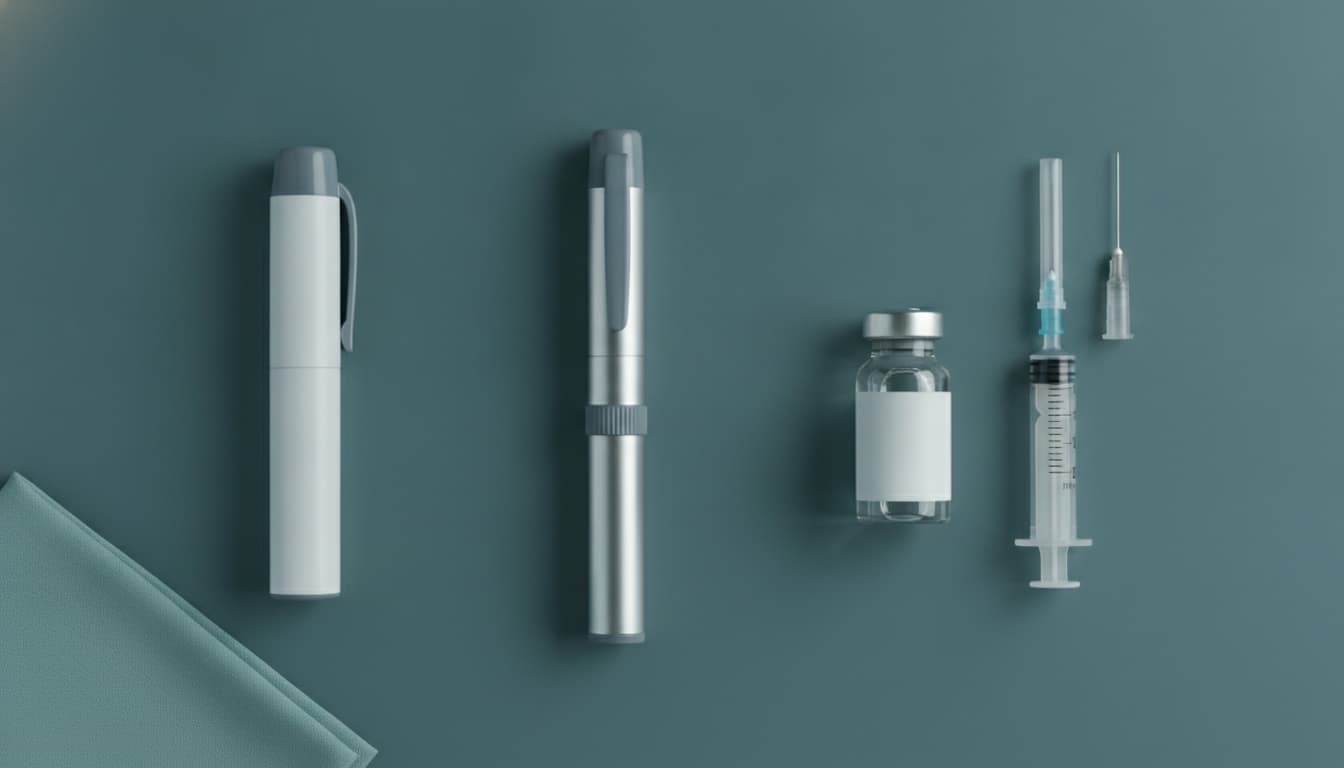
The differences that matter in practice.
- 01
Three delivery methods, one destination
An auto-injector, a manual pen, and a vial with a syringe all place medicine in the subcutaneous fat. They differ in how much the device does for you versus how much control you keep.
- 02
Auto-injector, the least hands-on
A single-use auto-injector hides the needle and delivers a fixed dose at the press of a button, which suits needle anxiety and shaky hands. You trade dose flexibility for simplicity and pay per device.
- 03
Manual pen, a middle ground
A pen lets you dial a dose and inject with a short attached or attachable needle. It balances convenience with some flexibility, which is why most GLP-1 medicines ship this way.
- 04
Vial and syringe, the most control
Drawing from a vial with an insulin syringe gives full control over dose volume and is usually the cheapest per dose, but it needs reconstitution or drawing-up skill and careful math.
- 05
Cost and waste differ sharply
Auto-injectors cost the most per dose and generate the most single-use waste; vial and syringe is the most economical but demands more from you. A pen sits in between on both counts.
- 06
Match the method to your needs and your prescription
Your medicine often dictates the format, but where you have a choice, weigh dexterity, needle comfort, dose flexibility, and cost. Our draw-up and pen guides cover the technique for each.
How this reference was written
- The technique we verified
- We verified each step against the relevant manufacturer Instructions for Use, Frid et al. 2016 (Mayo Clinic Proceedings), and the CDC injection-safety guidance. Where sources disagreed, we defaulted to the most conservative and noted the discrepancy.
- The sources we triangulated
- Peer-reviewed injection-technique literature, manufacturer package inserts, USP monographs, CDC and WHO published standards, and FDA labelling. Links and DOIs in the Sources section below. Unsourced claims are not published.
- The failure modes we tested
- We document known-wrong outcomes for the common mistakes, partial dose delivery, injection-site bruising, pen misuse, reconstitution error, and describe what the published literature says to do when they happen. The red-box call-outs are drawn from these failure modes.
- What we're still verifying
- Pen manufacturer Instructions for Use change. FDA labelling gets updated. A named credentialed reviewer (RN, NP, or PharmD) is joining the masthead by month 6. Until then, verify every technique decision with your own prescriber and the package insert that came with your medication.
What the literature answers next.
- What is the difference between an auto-injector and a syringe?
- An auto-injector hides the needle and delivers a fixed dose at a button press with minimal handling, while a vial and syringe gives you full control over the dose but needs more skill and math. Not medical advice.
- Which delivery method is cheapest?
- Vial and syringe is usually the most economical per dose, auto-injectors cost the most, and pens sit in between. The tradeoff for the cheapest option is more preparation and technique on your part.
- Is a pen or an auto-injector easier?
- An auto-injector is the most hands-off and best for needle anxiety or shaky hands. A pen adds dose flexibility for a little more handling. Both are simpler than drawing from a vial.
- Can I choose my delivery method?
- Sometimes. Your specific medicine often comes in one format, but where there is a choice, weigh dexterity, needle comfort, dose flexibility, and cost with your prescriber.
A new manufacturer Instructions-for-Use revision. A peer-reviewed injection-technique paper that reports a different outcome. An FDA label update. A change to USP chapter guidance. We revise this page within a week of the cited source changing and mark what changed at the bottom.
Sources
About The InjectCompass Editorial Team
The InjectCompass Editorial Team is a small group of writers working from published nursing-education literature, manufacturer package inserts, and peer-reviewed injection-technique research. Our content is reviewed against published best practice before publication. We are adding a named credentialed reviewer (RN, NP, or PharmD) to the masthead; until then, readers should verify all guidance with their own prescriber and the manufacturer package insert that came with their medication. If you spot an error, write to corrections@injectcompass.com, we want to know.
Related posts
Luer-Lock vs Slip-Tip Syringes: Which to Use
Luer-lock threads a needle on securely; slip-tip pushes on fast. How the connection differs and which suits home injections. Not medical advice.
5 min readU-100 vs U-40 Syringes: Why the Scale Matters
U-100 and U-40 syringes use different unit scales, so mixing them misdoses. How to tell them apart and why U-100 is standard. Not medical advice.
5 min readInjection Needle Sizes: 29G vs 30G vs 31G
Gauge and length conventions for subcutaneous injection from the published technique literature, plus ancillary syringe products. Not medical advice.
12 min readYour First Injection, a one-page cheat sheet.
A printable, step-numbered PDF covering supplies, technique, site rotation, and the three questions to ask your prescriber. Free.
By subscribing, you agree to our Privacy Policy. One practical email per week. Unsubscribe anytime.