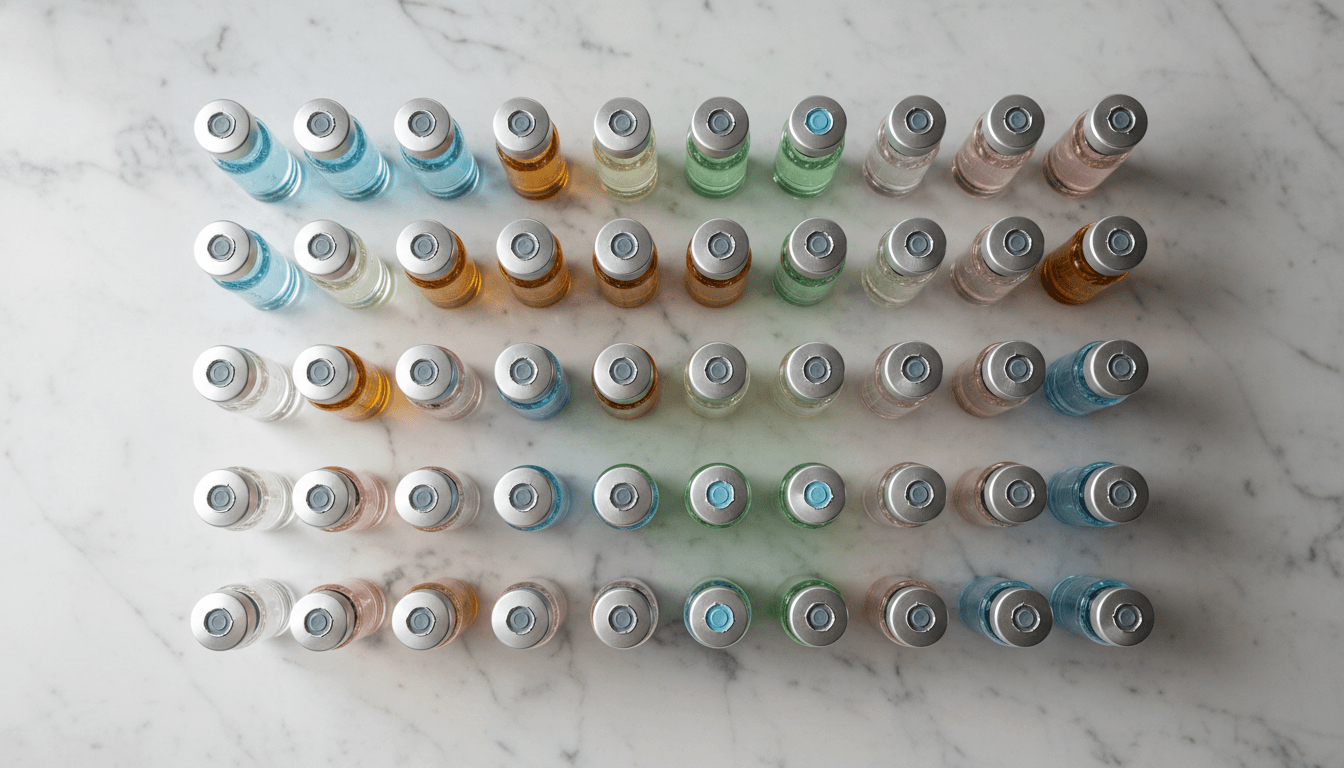
How to reconstitute compounded tirzepatide: mix the powder with bacteriostatic water, swirl gently, and verify concentration. Educational only.
Pre-injection checklist
- ✓Read the pharmacy label and mixing instructions: the strength, the diluent volume to add, and the beyond-use date after mixing.
- ✓Confirm the exact water volume with your pharmacy. This page explains technique only, it does not set any dose or volume.
- ✓Let both vials reach room temperature and lay everything out on the clean surface.
- ✓Wipe both rubber stoppers with an alcohol pad and let them air-dry fully.
Step-by-step guide
- 1
Draw the pharmacy-specified water volume
Draw up exactly the volume of bacteriostatic water listed on your mixing sheet. Because tirzepatide often ships in a small milligram amount, this volume decides the final concentration, so do not deviate from it without speaking to your pharmacy.
Pro tipAlways check the fluid is clear and colourless before injection. - 2
Run the water down the glass wall
Insert the needle through the tirzepatide vial stopper and let the water run slowly down the inside wall rather than jetting it straight onto the powder. A gentle stream is easier on the peptide.
Pro tipAlways check the fluid is clear and colourless before injection. - 3
Swirl, do not shake
Swirl the vial gently in a circular motion until the powder fully dissolves. Shaking creates foam and is described in compounding references as damaging to fragile peptides.
Pro tipAlways check the fluid is clear and colourless before injection. - 4
Inspect the solution
The finished solution should be clear and free of particles, matching what your mixing instructions describe. Do not use a cloudy, discoloured, or flaky solution.
Pro tipAlways check the fluid is clear and colourless before injection. - 5
Label and refrigerate
Write the mix date and beyond-use date on the vial and store it per your pharmacy's instructions, usually refrigerated.
Pro tipAlways check the fluid is clear and colourless before injection.
After the injection
- Store the reconstituted vial refrigerated per pharmacy instructions and honour the beyond-use date you noted.
- Use a fresh, sterile needle for the actual injection, not the mixing needle.
- Drop the mixing needle straight into the sharps container without recapping it.
Common mistakes
- The powder will not dissolve after gentle swirling, or particles or cloudiness remain.
- The solution is discoloured or has flakes floating in it, do not use it.
- Any uncertainty about the correct diluent volume or concentration, check with your pharmacy or prescriber before injecting.
Frequently asked questions
How do I reconstitute compounded tirzepatide?+
Draw up exactly the volume of bacteriostatic water your pharmacy specifies and let it run slowly down the inside wall of the powder vial. Swirl gently until everything dissolves, inspect the clear solution, and label the vial with the mix date and beyond-use date. This page explains the technique, not the dose.
Is mixing tirzepatide different from mixing semaglutide?+
The technique is the same: run the water down the glass wall, swirl instead of shake, and inspect the solution. The difference is the milligram strength and the diluent volume your pharmacy specifies, which together set the concentration. Always follow your pharmacy's mixing sheet.
What water do I use to mix tirzepatide?+
Compounding instructions usually specify bacteriostatic water for injection (with 0.9% benzyl alcohol) because it supports multi-dose withdrawal from a vial. Sterile water, which has no preservative, is described for single-use. See our bacteriostatic vs sterile water guide for the difference.
How long does reconstituted tirzepatide last?+
The beyond-use date after mixing is set by your compounding pharmacy on the label, and it depends on the formulation and storage. Keep the mixed vial refrigerated as directed and use it within that window. See our guide on how long reconstituted peptide lasts for more.
Does the water volume change my dose?+
Yes, indirectly. The diluent volume sets the concentration in milligrams per millilitre, which in turn sets how many syringe units equal a prescribed dose. That is why the pharmacy fixes the volume. Our peptide calculator shows how volume and concentration relate.